Powered by Blogger.
Showing posts with label Network. Show all posts

How Computer Networks Work- Introduction to Devices

What is Computer Networking?

Networking is the practice of linking computing devices together with hardware and software that supports data communications across these devices.

Computer Networks Work- Introduction to Devices

During the past 20 years, the planet has gradually been covered by computer networks of various kinds. Understanding the basics of how these networks work helps us learn how to better use them and also increases our awareness of the changing world around us. This installment of our series on How Computer Networks Work examines devices - hardware systems that connect to the network and communicate with each other.

What Makes a Network Device

Not every computer, handheld gadget or other piece of equipment is capable of joining a network. A network devicepossesses special communications hardware to make the necessary physical connections to other devices. Most modern network devices have communication electronics integrated onto their circuit boards.
Some PCs, older Xbox game consoles, and other older devices do not have built-in communications hardware but can be set up as network devices by plugging in separate network adapters in the form of USB peripherals. Very old desktop PCs required physically inserting separate large add-in cards into the system motherboard, originating the term Network Interface Card (NIC).
Newer generations of consumer appliances and gadgets are being built as network devices when older generations were not. For example, traditional home thermostats did not contain any communications hardware, nor could they be joined to a home network via peripherals.
Finally, some kinds of equipment do not support networking at all. Consumer devices that neither have built-in network hardware nor accept peripherals include older Apple iPods, many televisions, and toaster ovens.

Special Purpose Network Devices

Client and server nodes can be added or removed from a network without blocking the communication of other devices that still remain. Certain other types of network hardware, however, exist for the sole purpose of enabling a network to run:
  • network hub enables any node connected to it to directly send data to others
  • Network switches perform the same function as hubs but include additional hardware logic that opens up multiple communication paths allowing multiple connected nodes to send data directly to each other instead of to all others on the network as with hubs
  • Network routers further expand on the capabilities of network switches by supporting connections outward from itself to other networks, joining them together without disrupting the functionality of each one individually.
  • network repeater receives the physical signals sent across a network connection and amplifies their strength (such as electrical or radio power) to enable the signal to travel longer distances
  • A less common type of device noaways, the network bridge device connects two different kinds of physical network links together that otherwise would be incompatible, such as bridges that enable wireless devices to join a wired network. (Modern bridge technology is often physically integrated inside other types of devices.)

Networking Basics - Essential Concepts in Computer Networks

Beginners can study these key networking concepts and technologies to learn the basics of computer networking fast.When looking at networking basics, understanding the way a network operates is the first step to understanding routing and switching.Part 1:Networking Basics provide information on types, technology used and products of computer networks by Lantronix.In this module, you'll learn about the basics of networking and how it can be helpful to your job search. We'll also talk about different Computer networking strategies.
Computer Networking Basics
Start learning about computer networking basics by exploring this guide to the important concepts and technologies. The A-Z terms and Frequently Asked Questions (FAQ) lists span many essential topics, while other sections of this guide each focus on one core area of networks.

What is Computer Networking?

Networking is the practice of linking computing devices together with hardware and software that supports data communications across these devices.

3 SUBCATEGORIES IN NETWORKING BASICS - ESSENTIAL CONCEPTS IN COMPUTER NETWORKING
  • Networking for Beginners - Dictionary of Network Terminology
  • Frequenty Asked Questions (FAQs) on Basic Networking Concepts 
  • Computer Architecture Basics 

How Computer Networks Work - Devices

This installment of our series on How Computer Networks Work examines the hardware devices that connect to a network and communicate with each other.

How Computer Networks Work - Interconnects

This installment of our series on How Computer Networks Work examines the physical interconnects that glue devices together.

How Computer Networks Work - Protocols

Protocols like TCP/IP are the "languages" that computers, phones and other device use to communicate with each other over network connections.

Types of Computer Networks (LAN, WAN, MAN)

Types of Computer Networks

From sharing files you can view, modify, and copy files stored on a different computeron the network just as easily as if they were stored on your computer.Networking is required to make accessible communication between computers possible by a network connection. Networking allows for many possibilities. Computer Network Types - Learn Data Communication & Computer Network in simple and easy steps starting from their overview.
Types of Computer Networks (LAN, WAN, MAN)

Computer Network an Overview

What is Network? • A network consists of two or more computers that are linked in order to share resources (such as printers and CDs), exchange files.

Types of Networks: LAN, WAN, WLAN, MAN, SAN, PAN

There are so many different types of computer networks in existence, it can be hard to understand the differences between them.Different types of (private) networks are distinguished based on their size (in terms of ... It's a group of computers which all belong to the same organization

Computer Networks Brief History

Today, computer networks are the core of modern communication. All modern aspects of the public switched telephone network (PSTN) are computer-controlled. Telephony increasingly runs over the Internet Protocol, although not necessarily the public Internet. The scope of communication has increased significantly in the past decade. This boom in communications would not have been possible without the progressively advancing computer network. Computer networks, and the technologies that make communication between networked computers possible, continue to drive computer hardware, software, and peripherals industries. The expansion of related industries is mirrored by growth in the numbers and types of people using networks, from the researcher to the home user.
Computer Networks History

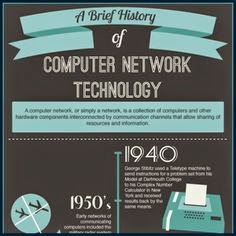
The following is a chronology of significant computer network developments:

  • In the late 1950s, early networks of communicating computers included the military radar system Semi-Automatic Ground Environment (SAGE).
  • In 1960, the commercial airline reservation system semi-automatic business research environment (SABRE) went online with two connected mainframes.
  • In 1962, J.C.R. Licklider developed a working group he called the "Intergalactic Computer Network", a precursor to the ARPANET, at the Advanced Research Projects Agency (ARPA).
  • In 1964, researchers at Dartmouth developed the Dartmouth Time Sharing System for distributed users of large computer systems. The same year, at Massachusetts Institute of Technology, a research group supported by General Electric and Bell Labs used a computer to route and manage telephone connections.
  • Throughout the 1960s, Leonard Kleinrock, Paul Baran, and Donald Davies independently developed network systems that used packets to transfer information between computers over a network.
  • In 1965, Thomas Marill and Lawrence G. Roberts created the first wide area network (WAN). This was an immediate precursor to the ARPANET, of which Roberts became program manager.
  • Also in 1965, the first widely used telephone switch that implemented true computer control was introduced by Western Electric.
  • In 1969, the University of California at Los Angeles, the Stanford Research Institute, the University of California at Santa Barbara, and the University of Utah were connected as the beginning of the ARPANET network using 50 kbit/s circuits.
  • In 1972, commercial services using X.25 were deployed, and later used as an underlying infrastructure for expanding TCP/IP networks.
  • In 1973, Robert Metcalfe wrote a formal memo at Xerox PARC describing Ethernet, a networking system that was based on the Aloha network, developed in the 1960s by Norman Abramson and colleagues at the University of Hawaii. In July 1976, Robert Metcalfe and David Boggs published their paper "Ethernet: Distributed Packet Switching for Local Computer Networks and collaborated on several patents received in 1977 and 1978. In 1979, Robert Metcalfe pursued making Ethernet an open standard.
  • In 1976, John Murphy of Datapoint Corporation created ARCNET, a token-passing network first used to share storage devices.
  • In 1995, the transmission speed capacity for Ethernet was increased from 10 Mbit/s to 100 Mbit/s. By 1998, Ethernet supported transmission speeds of a Gigabit. The ability of Ethernet to scale easily (such as quickly adapting to support new fiber optic cable speeds) is a contributing factor to its continued use today.